What kind of Lid ? [What Kind of Motorcycle Helmet Should I buy?](#What Kind of Motorcycle Helmet Should I buy?) [What should I look for in a helmet?](#What should I look for in a helmet?) [Should I pay for an expensive helmet?](#Should I pay for an expensive helmet?) [Yeah, but will a helmet really save me? I heard they might dangerous to wear.](#Yeah, but will a helmet really save me? I heard they might dangerous to wear)
What Kind of Motorcycle Helmet Should I buy? Simple answer: One that you will wear!
I always wear a helmet when I ride. Yeah it’s sometimes a pain, but it’s worth it when you need it.
I have many friends who motorcycle. About half of them wear a helmet and half don’t. I’ve had two people close to me die in motorcycle accidents. My brother, Jeff Redifer in 1990, and more recently a very close friend and former next door neighbor in 2006. Neither one of them were wearing a helmet. Nobody knows if they would have lived if they had a helmet on, but I wish they both would have been wearing one, on the chance it would have saved them.
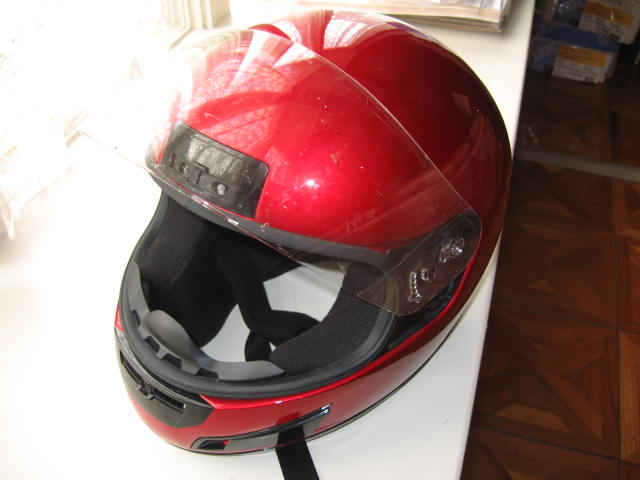
Enough with the lecture - what kind of helmet? Any kind is better than none, but I currently use three different motorcycle helmets. I have a full-faced helmet with a clear shield that I use on my street bikes. I like the wind protection from a full-faced helmet, and I know that is the safest kind.
I also have a 3/4 helmet that I bought to ride with my Harley Buddies. It doesn’t offer as much protection as the full-face, but I don’t get as much grief from the Harley guys, who universally don’t wear helmets at all.
For my dirt bike riding, I have a Motocross style helmet. They’re a full-face style, but they don’t have a face shield, they have a bigger eye opening so you can wear goggles with them, and they have an opening at the chin that allows more air in, because dirt biking is so strenuous, your generally out of breath. If you wore a standard full face helmet while motocrossing, the face shield would fog up all the time due to your breathing hard.
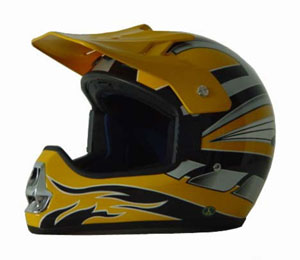
Motocross helmets also get dirty and beat up a bit more than road helmets, so sometimes they aren’t as pretty.
What should I look for in a helmet? First thing when looking for a helmet. Turn it around, and look at the base of the back, and look for a sticker that says “DOT”. It’s even better if it also says “Snell Approved”.
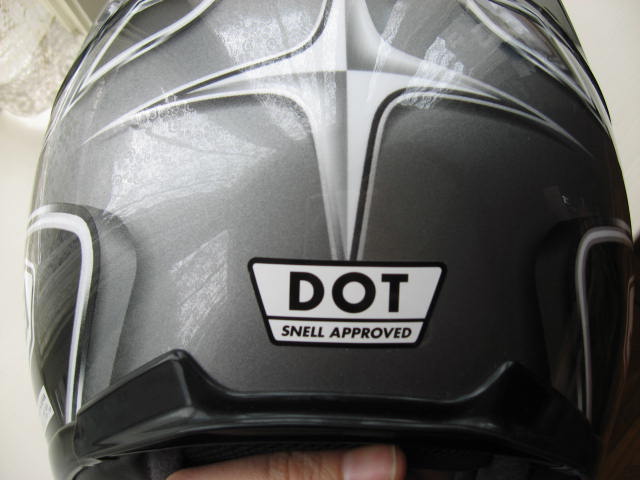
What does that sticker do? Well, it tells you the helmet is approved by the Department of Transportation, and it offers a tested level of protection. The Snell Safety Foundation is a private testing foundation that also tests helmets to a slightly higher level than DOT, but it costs more money for the manufacturer to get a Snell Rating. DOT is an acceptable level of safety, Snell is better. If a new helmet doesn’t have a rating sticker on it, don’t bother.
Is it expensive to get a helmet with a DOT or Snell rating? Not at all, to get a Dot rated helmet. I recently did a web search and found some pretty nifty looking, DOT rated, helmets on clearance for $29.95 - If you can’t afford that, you can’t afford to ride. I’ve often seen DOT rated helmets in the $90-$100 range. Snell rated helmets are usually more expensive - probably starting in the $150 range and going up.
Even my motocross helmet has a DOT sticker on it. So, can you buy helmets without a DOT sticker? Yes, you can. Really really cheaply made helmets may not be DOT approved. However since you only have to spend $90 (or less if you find a bargain) on a DOT helmet, why bother.
But there is another class of helmet that isn’t approved. Specialty helmets often are not DOT approved. Some states have helmet laws that force riders to wear helmets. Folks that normally wouldn’t wear a helmet, but have to because of the law, often cheat themselves out of the protection of a helmet, by buying something that looks like a helmet, but really is just a sham
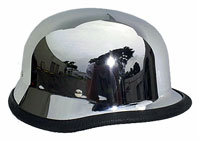
It’s not approved, it offers very little protection. It’s really just a fashion accessory. Most half-helmets like the one shown at left are not DOT approved. I’ve even seen motorcycle cops wearing half-helmets - which is really dumb in my opinion.
After the certification, it’s all about fit and comfort. First sizing and fit: Everybody has a different size and shape head. Unless your a Formula 1 driver, however, the helmet manufacturer is unlikely to be willing to make a helmet specifically for you. So, what they do is they make different sizes. Usually they come in S, M, L, XL, and XXL, some manufacturers still sell helmets in hat sizes. But on other thing, is they all tailor there helmets to different head shapes as well. Some people have thin heads, some round and wide. Different manufacturers make their helmets for different heads. They do this by changing the shape and thickness of the interior padding, so they will all fit different. You have to try them on to figure out what fits - that’s why internet, or mail order helmet purchasing is difficult. The helmet should fit your head snugly - it shouldn’t flop around much even before you strap it. After you strap it, it shouldn’t flop at all.
By the way, you should always strap it, or don’t bother wearing the helmet. I saw some guys on one of those bike trick shows riding around with the straps hanging, and I couldn’t believe how stupid that is. The helmet shouldn’t be so tight, that it’s uncomfortable after an hour or so, either. You usually have to try a few, from a couple different manufacturers to find the right one.
That takes care of the safety end of it. Beyond that, there are convenience features built into many helmets. Various air vents that open and close - different visor shades and colors. Some of these work well, some don’t. You’ll really have to guess, because you have to ride for awhile to evaluate these, and of course you have to buy the helmet to ride with it.
Which color? You can buy helmets with every color of the rainbow, and some of the most radical graphics you can imagine. Some people even like their helmets custom painted. Some folks like a helmet that matches their motorcycle. I’ve heard that some colors can be more noticeable than others. Most companies make a yellow/orange helmet - almost like construction yellow - that is supposed to be pretty visible, and may offer a bit more safety. Some helmets have night reflection built in. Other than that, buy what you like.
What about used? If you can’t afford a new helmet, a used one might work. Often people sell used motorcycles with matching helmets. The problem here is that your not likely to get the fit as good in a used helmet, than if you try out several new ones. If you get lucky with fit, however, every helmet is used as soon as it leaves the store, so there’s nothing wrong with a used one. Don’t buy or use a helmet that has been through a crash, however. Helmets are throw-aways after a crash, because the interior foam is supposed to crush permanently with you hit something - that’s where the protection comes from.
Also be aware of age: Helmet manufacturers tell you to buy a new helmet every five years, because the foam degrades over time. Well, I take that with a grain of salt - kinda like the oil change companies saying you need to change your oil every 3,000 miles. But, over a long time, the foam does degrade. My first helmet was a Bell Star helmet I bought in 1982 for about $150.
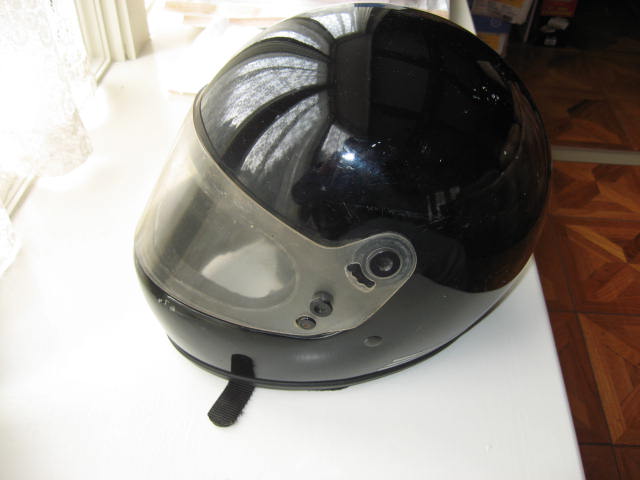
It was a good helmet, DOT and Snell approved, and worked well for me for about 20 years.
However, I’ve had it on a shelf in my garage, since I bought a replacement in 2001. I took it off the shelf the other day to try it on. And I got covered with a bunch of crumbling black plastic material. The interior padding foam - not the protection foam - had disintegrated completely, leaving the helmet loose on my head. Also, the face shield had yellowed a bit, and the rubber gasket around the eye opening was lost about 10 years ago.
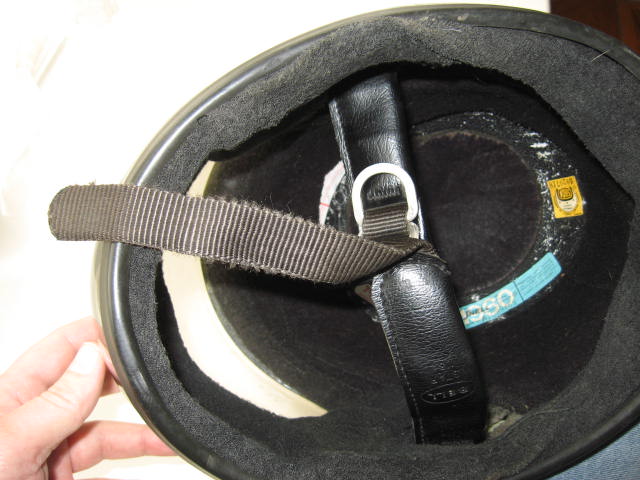
Notice how the strap is showing some wear also. So, even though the shell of the helmet is sill serviceable, and it appears the safety foam is still intact, this helmet is probably going into the trash. It’s not worth it to put a new interior in it, because the new helmets are so much better than this one and not that expensive. I never crashed with it, in probably 20,000 miles of riding - so it did it’s job.
Should I pay for an expensive helmet? If you have the money, yeah, it can’t hurt.
But if you don’t have the money, don’t worry about it - as long as your helmet is DOT approved, and fits right, and more importantly, you wear it, you’re OK.
One expensive helmet manufacturer put out a statement about paying for their helmets that goes something like this: “If you have a $50 head, go ahead and buy that $50 helmet, otherwise buy one of ours”
Well, I don’t exactly agree with that. Here’s why. I currently own five motorcycle helmets. The BellStar helmet from 1982 that I show above that I’m about to throw away. A Fulmer motocross helmet that I bought about 7 years ago for $89. An HJC full face that I bought in 2001 for about $150. A Shoei 3/4 helmet that I bought about five years ago - it cost about $250. And a Shoei full face that I just bought recenlty - it retails for $475 but I got in on clearance for $330.
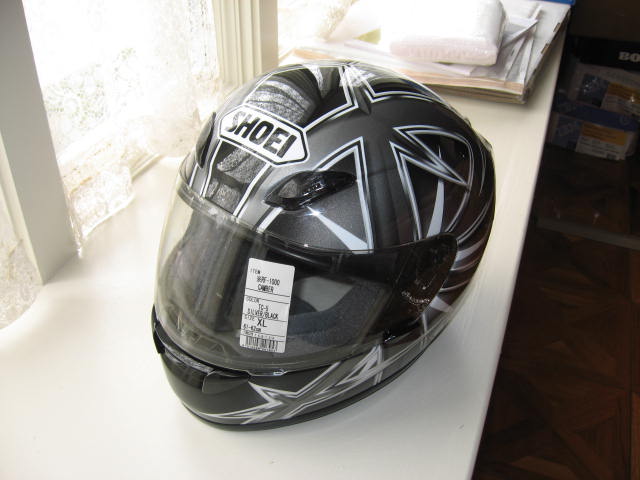
They’re all good. They all fit well, they all will protect me in a crash. So why did I buy the new expensive one? Because I could, and I saw it for a good price, and it supposedly has better aerodynamics - the little I’ve ridden with it proves this to be true, and maybe, just maybe it will offer a slight bit better protection in a crash. Shoei would like for the latter to be the case, but I bet not.
The other thing about Motorcycle helmets: the high end manufacturers want you to buy a new one every year - so they come out with new graphics packages on them. They want you to buy what the pros wear - so they sponsor pro riders to wear their brand. All that costs money, and I think it’s a bit like golf equipment - the expensive stuff may be very slightly better than the cheap stuff, but most would be hard pressed to notice.
The one thing I don’t like about the Shoei model shown above and other expensive helmets is that you can’t remove the advertising logo from the helmet. It’s painted on - which I hate. The HJC helmet I have used stickers - peel them off, and you have a generic helmet. I guess Shoei wants advertising from all their customers on top of the high price - or maybe the customers want to show off their expensive helmet. But that cuts both ways. I don’t want thieves to know it’s an expensive Shoei helmet.
Buy the best you can afford, make sure it fits properly and wear it.
Yeah, but will a helmet really save me? I heard they might dangerous to wear. Every anti helmet crusader will trot out examples of someone somewhere who broke their neck as a result of a motorcycle helmet. Then they’ll cite statistics that most motorcycle deaths aren’t caused by head injuries at all - but chest injuries or something else. . They’ll also say that even the strongest helmet can’t help in many crashes.
However, I only need to cite a few examples to prove my case that you should always wear a helmet.
First, I will ask you, as a motorcycle rider a simple question. If you know, with certainty, that you will suffer a hard crash on the next motorcycle ride you take, will you wear a helmet or not? If they are honest, every rider will answer yes. The only reason riders don’t wear helmets is that they think they will not crash.
I go back to the story I told in the beginning. In the summer of 1990, while my wife and I were vacationing in Europe, my older brother, Jeff, suffered a fatal motorcycle accident. He was driving too fast for conditions at night, slid off a turn and impacted what I heard was a fencepost. He died that night of a ruptured aorta. He wasn’t wearing a helmet, and I’m sure it wouldn’t have protected his aorta if he had been. However, I wish he had put the helmet that was strapped to the back of his motorcycle onto his head before that ride - on the outside chance it might have saved him. Maybe the helmet would have deflected a bug or a gust of wind, or whatever else distracted him and caused him to crash. I don’t know.
Third example: When I was in high school - so probably 1976 or 77, a kid in our town suffered a horrible death when he was riding a mini bike down the sidewalk near the school and collided with a school bus that was turning into the driveway - somehow his head ended up under the bus wheel and was crushed. He wasn’t wearing a helmet, but most believed it wouldn’t have mattered if he did.
A friend of mine and I argued about this, so we decided to conduct an experiment. We decided to take an old, but high quality motorcycle helmet and drive over it with a truck and see if it crushed. My friend’s dad owned a bunch of trucks with his construction business, so we picked one that was closest in size and weight to a school bus and started our experiment. First we found out it is very difficult to run over a motorcycle helmet with a truck in a gravel parking lot - the tires kept pushing the helmet out of the way. The only way we found to get the truck wheel on top of the motorcycle helmet was to build a gravel ramp in front of the helmet. It worked, but I was amazed at the result. The helmet deflected an inch or so - quite a bit - but it did not break under the full weight of the pretty large truck. In fact, mine and my friend’s opinion was that the deflection was not enough to break the skull of the wearer. We ran over the helmet several times, and it never broke. So the kid would have had a good chance to live if he were wearing a helmet that day. First, it’s unlikely that the bus would have run over him, but if it did, it may not have killed him. I learned that helmets are incredibly strong.