In 1991, when we were starting a family, we bought a house on the northeast side of Indianapolis in a nice neighborhood in the woods. Nearby was a large reservoir, Geist Lake, which was rapidly being built out with some of the nicest houses in the state. Most of the waterfront homes are fairly lavish, 6,000 to 10,000 square feet and up, and at one time the area was listed among the top 50 neighborhoods in the United States.
One day in late fall, early November I think, when the kids were little, we went out to the boat ramp at Geist to feed the ducks. There were some used boats sitting out by the ramp. We couldn't possibly afford to live on the lake, but I went in and talked to the guy at the marina anyway. It turned out we could afford to buy a boat and rent a slip. We did, and our boating adventures began.
For the next two years we kept a slip on Geist and came to love boating as a family. At the same time my work was going well and our finances were improving. One day we were up in an area called Feather Cove and saw a beautiful house with a for-sale sign on the waterside. I called and set up a walk-through. The house was even more than I expected, and so was the price: far out of reach, even for our improving fortunes.
By 2003 we had moved the boat off Geist, because we had bought a vacation condo on Lake Monroe in Bloomington. We loved lake life. Our house was starting to feel cramped, and we were thinking about a lake house in Florida. We even picked out a lot on a lake near Orlando and Disney World. That plan fell apart, more or less, when Tiger Woods bought five lots at the end of the street to build a large house. So we thought: what about Geist?
We started looking at the houses we could afford, and every one of them had problems. Then one day I saw it. The house we had toured years before was back on the market at a greatly reduced price. I did some digging and found it was a somewhat distressed sale. The house had never really been lived in; the man who built it was getting older, going through a divorce, and needed out. I made him a lowball offer I was sure he would never take, a lowball that was about the most I could afford.
He took it. We had a month to put our old house on the market and move. Fortunately it sold quickly, the financing came through, and in October 2003 we moved onto Geist Lake. We've been there ever since.
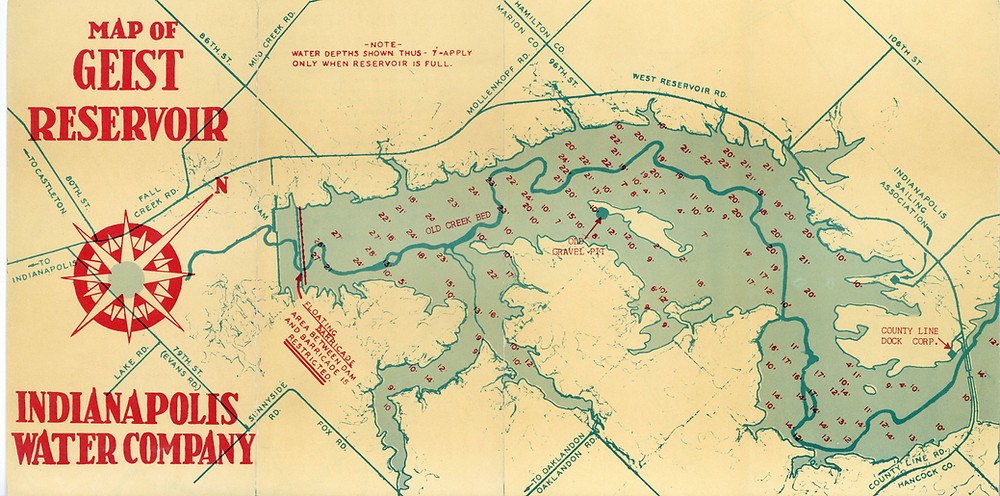
That house sits on a reservoir with a longer and stranger history than most of the people boating on it realize. Geist is tucked into the northeast corner of Indianapolis and the southeast corner of Fishers, with small pieces reaching into Lawrence, Fortville and McCordsville. Most people who live here call it a lake. It was built as plumbing.
A lake built for drinking water
Around the time of World War I, Indianapolis drew its water from the White River by way of the Central Canal, from Fall Creek, and from wells. Engineers at the Indianapolis Water Company could see that those sources would not keep up with a growing city, and as early as 1913 they were estimating the shortfall. The company's president, Clarence H. Geist, pushed for a reservoir to get ahead of it.
Through the 1920s the company quietly bought up roughly 5,700 acres across northern Marion, southeastern Hamilton and northwestern Hancock counties. In 1941 it built a dam across Fall Creek at the south end of the valley. The water backed up about seven and a half miles, covering some 1,900 acres and creating storage for about 6.9 billion gallons. The reservoir was full by March 17, 1943, and began supplying the city that year. Geist himself never saw it; he had died five years earlier, and never lived in Indiana at all.
Before the water could rise, the valley had to be emptied. Contractors removed every building, fence and bridge in the flood zone. Timber worth selling went to lumber dealers, the rest was burned, and then the whole valley floor was given a controlled burn so the new reservoir wouldn’t taste of rotting vegetation. Four bridges stood in the way, including the Roberts Covered Bridge, built in the 1880s just upstream of the dam site. Each was taken apart, its pieces marked for reassembly, and handed back to the county highway departments. Nature didn’t wait for the schedule: heavy rains in December 1942 overwhelmed the dam’s outlet pipes, and crews had to race the rising water to finish pulling out the last bridges. Until it was named for Geist, the project was known as the Fall Creek or Oaklandon Reservoir.
When it opened, Geist was the second-largest man-made lake in the state. Several larger reservoirs have since been built, Lake Monroe among them, and Geist now ranks fifth.
The town underneath
The flooded land was not empty. The rising water covered about 535 acres of woodland and 45 homesteads, including the small village of Germantown, which sat on the north bank of Fall Creek near the Hamilton–Marion county line. A long-running local story says you can see a church steeple when the water is low.
The official histories are skeptical. They say no record of a church there has ever been found and that there is no proof any buildings remain. I can only report what I saw. I know exactly where Germantown lies under the water and where the steeple was supposed to be. When we first started boating here about thirty years ago, there was something sticking up out of the water at that spot. Whatever it was, it is long gone now. There is at least some physical evidence on my side: when local historian Ed Fujawa compared 1937 and 2019 aerial photos, he found what appear to be the remains of building foundations still visible near a small island at the Germantown site.
From public shoreline to private neighborhood
For its first two decades, Geist was run more like a park than a neighborhood. Bank fishing drew thousands of people, and the lake produced some of the largest crappie and catfish in the state. Boating was banned until 1953, but the Indianapolis Sailing Club was based on the lake and raced there. The water company turned away more ambitious ideas. One developer wanted to build a lakeside resort complete with a floating dance hall, and lost interest when told the water level would rise and fall with the city’s demand. Another entrepreneur proposed running a seaplane charter off the reservoir and was turned down.
That changed in 1960, when the water company created a subsidiary called Shorewood and, a year later, announced plans to turn the land around the lake into an exclusive subdivision. The fight lasted nearly twenty years. Many Marion County residents wanted the land made into a public park instead, at a time when the area had no state park close by. In 1978 the Metropolitan Development Commission approved Shorewood's rezoning request, and construction on the first two subdivisions, Masthead and Beamreach, began in 1980. By the mid-1980s much of the shoreline had been built out, and the boom has not really stopped since.
Famous and infamous neighbors
A lake lined with houses like these has drawn its share of well-known residents. Reggie Miller of the Pacers has owned a couple of houses on Geist, including one directly across the water from ours. Paul George, Reggie Wayne and Andrew Luck have all lived here. More recently Pat McAfee, the former Colts punter turned ESPN and sports-media mogul, bought a house on the lake, and he broadcasts his show from nearby.
IndyCar drivers Scott Dixon and Tomas Scheckter lived here too. Tomas lived right next door to us for ten years, and the stories from that stretch deserve a page of their own. Angie Hicks of Angie’s List lives here, and so did Governor Mitch Daniels, who famously skipped the governor’s mansion and stayed in his Geist home.
We’ve had a few notorious residents as well. In January 2009, Geist resident Marcus Schrenker, an investment adviser facing a securities-fraud investigation, a half-million-dollar court judgment and a divorce, tried to fake his own death. Flying his own plane over Alabama on a Sunday evening, he radioed that his windshield had imploded and he was bleeding badly, put the plane on autopilot, and parachuted out into the dark. The empty plane flew on and crashed in the Florida Panhandle. Schrenker had stashed a motorcycle in a storage unit in Alabama the day before and rode off on it. The national media had a field day. Two days later, U.S. Marshals found him alive at a campground near Quincy, Florida.
A few years later came an even more infamous neighbor. Tim Durham lived in a Geist-area mansion of well over 20,000 square feet. I’ve been inside it, and the enormous garage was full of some of the nicest cars in the world at the time. His company, Obsidian Enterprises, occupied the 48th floor of the Chase Tower, then the tallest building in Indiana. He also bought into National Lampoon, the humor franchise behind the magazine and movies like Animal House and Vacation, and eventually became its CEO. For a while he was a darling of the business press. For his 45th birthday in 2007 he threw a Playboy-themed party, flying in some thirty glamour models from Los Angeles and picking them up at the airport in cars from his collection. He was a real piece of work.
It was all built on other people’s money. Durham was a lawyer by training, and he set things up with care. In 2002 he and a partner bought Fair Finance, an Akron, Ohio, consumer-loan company that funded itself by selling investment certificates to ordinary Ohio savers. Because Fair raised and deployed its money almost entirely within Ohio, it answered only to Ohio securities regulators rather than the SEC. Under Durham it stopped behaving like a lender and became his personal bank. Within seven years, Durham, his partners and their companies owed Fair more than $168 million, about 70 percent of its assets. That money went to his other businesses and his lifestyle, and new investors’ money paid off the old ones. Even the décor matched the swagger: true to the Obsidian name, both the Geist house and the downtown office were trimmed in glossy black stone.
The FBI raided his offices in November 2009, and Fair collapsed. Durham was convicted of defrauding more than 5,000 investors of about $250 million, earning the nickname “the Madoff of the Midwest.” The case had an uncomfortable local angle: Marion County’s own prosecutor, Carl Brizzi, was a close friend and one of Durham’s biggest political beneficiaries. He partied at the Geist mansion, flew on Durham’s jet, and was named to the Fair Finance board before the scheme collapsed. Brizzi was never implicated in the fraud itself, but the relationship helped end his political career. Both Schrenker and Durham went to prison; Durham was sentenced to 50 years.
Life on the lake
The house has every amenity you could want, and it has been a great place for the kids to grow up. When we first moved in, it seemed to take forever to walk from one end to the other.
One of my favorite stories from those first weeks: Drew and Lindsey both wanted the big bedroom overlooking the lake. There was a nearly identical bedroom on the front of the house, just without the view. Drew negotiated with Lindsey and paid her $25 for the lake side. A few weeks later he was showing it off to some friends and told them, “That is a $25 view right there.”
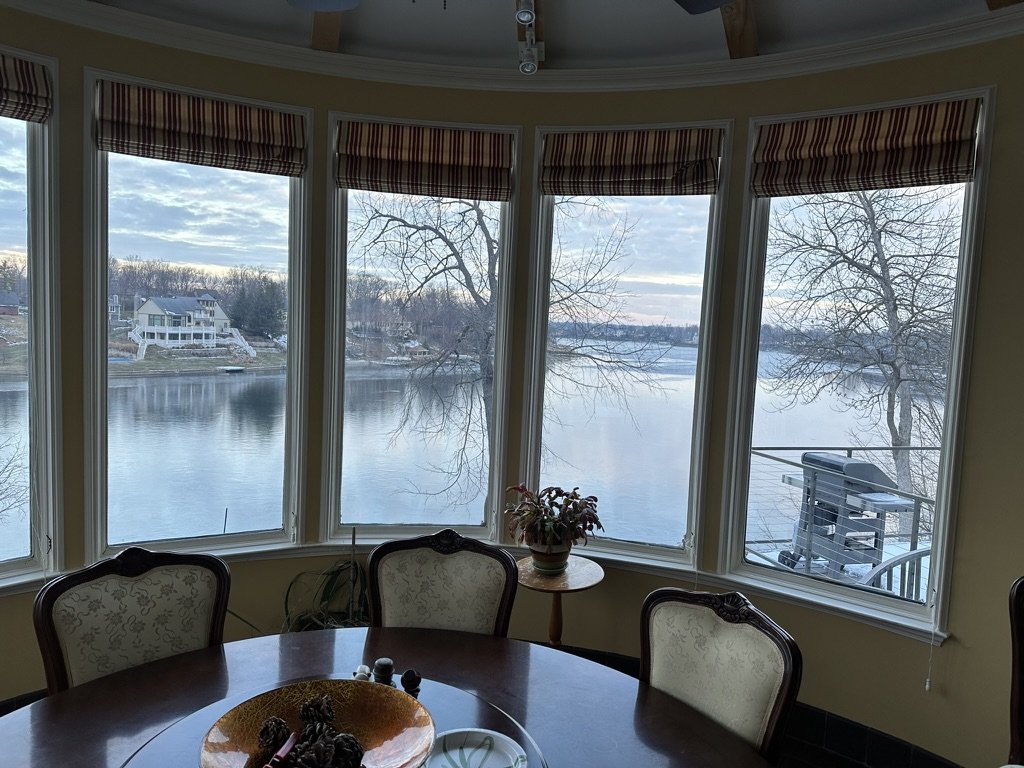
Over the years we've had powerboats, sailboats, WaveRunners and kayaks, and for the last ten years or so a pontoon boat. We've hosted countless lakefront parties and watched the fireworks from the water. And from our panoramic windows we've watched the wildlife: blue herons, owls, geese, ducks, swans, hawks, even pelicans, along with foxes, turtles, mink, deer and the occasional coyote.
These days the kids are grown and gone, and the house is too big for the two of us. So far, though, we haven't been able to part with it.